

Nobody really warns you about the tugging. Months after your cesarean, you reach up for something on a high shelf, or roll over in bed, or laugh a little too hard, and there it is. A pulling sensation across your lower abdomen that feels like a seatbelt you cannot unbuckle.
Sometimes the area above the scar feels numb and puffy. Sometimes the scar itself feels fine and your low back is the thing that hurts. Sometimes it is just a strange, tight, disconnected feeling in a part of your body that used to feel like yours.
All of that is common, and all of it is treatable. Here is what is actually going on under that line, when it is safe to start working on it, and what a c-section scar massage session really involves.
What is actually happening under that scar
A cesarean is not one incision. It is several. To get to your baby, a surgeon moves through skin, fat, fascia, and muscle, and each of those layers heals on its own timeline.
Your body repairs itself with collagen, laid down fast and laid down messy. Where healthy tissue is organized and glides, new scar tissue is dense and disorganized. It can bind layers together that are meant to slide past each other. That is what most people are feeling when they describe a pull, a tether, or a spot that feels stuck.
Because fascia is continuous through your whole body, a restriction at the front of your abdomen does not always announce itself there. It can show up as low back tension, hip tightness, or a change in how you stand. This is one reason a therapist may ask about your cesarean during an appointment you booked for something else entirely.
The numbness is a separate thing. Small sensory nerves in the skin are cut during surgery and regenerate slowly. Some sensation usually returns over the first year or two, and some patches may stay quieter permanently. That is normal.
When it is safe to start
The honest answer is that there are two gates, and you need to clear both.
Gate one is your incision. It needs to be fully closed, dry, and free of any signs of infection. No scabbing, no openings, no discharge, no heat or spreading redness. HealthLink BC notes that a cesarean incision generally takes four weeks or more to heal, and that occasional pain in the area during the first year is not unusual.
Gate two is your care provider. Most people are cleared for hands-on work at their six to eight week postpartum follow-up. The Society of Obstetricians and Gynaecologists of Canada uses that same appointment as the checkpoint for resuming regular activity. If your recovery has been complicated, or if you had an infection, a hematoma, or a wound that opened, your timeline may be longer. Ask specifically. A general clearance to exercise is not automatically a clearance for direct scar work.
Before that six week mark, a massage therapist can still help. They work around the area rather than on it, easing the shoulder, neck, and upper back tension that comes with feeding a newborn and hauling a car seat around. That is a real appointment worth booking, and it is not the same as scar work.
On the other end, there is no expiry date. If your youngest is seven and your scar still pulls, tissue is still responsive. Older scars often take a few more sessions to change, but they do change.
What a session actually looks like
The first appointment is mostly conversation. Your therapist will ask about your delivery, how healing went, what you feel and where, what makes it worse, and what you want to get back to. That last question matters more than people expect, because getting back to running and getting back to picking up a toddler without wincing are two different plans.
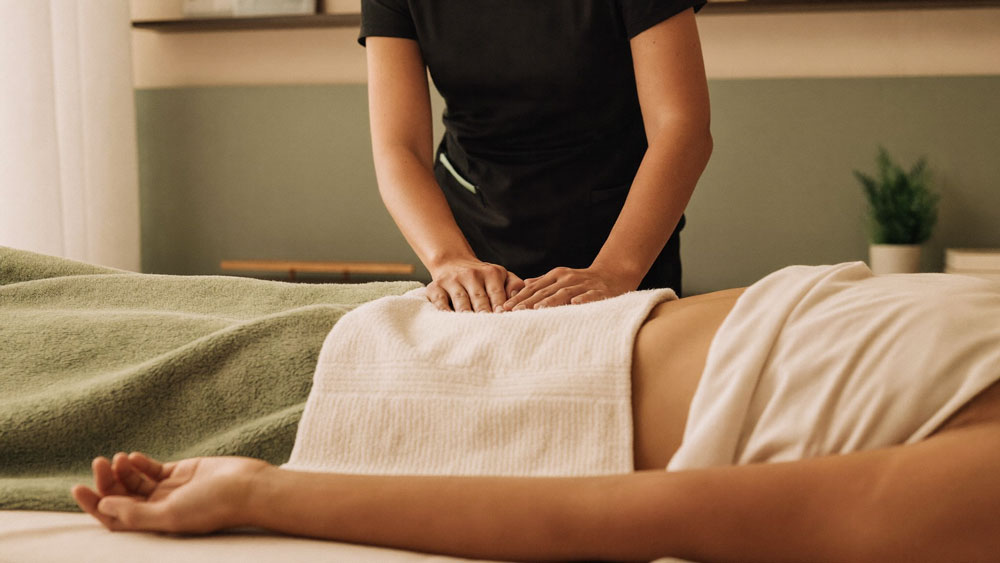
Then, with your consent and full draping the entire time, they assess how the scar sits, how the skin around it moves, and where the tissue glides freely versus where it catches.
Hands-on work often starts nowhere near the scar. Therapists commonly begin with the surrounding abdomen, the ribs, and the hips, giving the area some slack before asking anything of the scar itself. From there, techniques may include gentle skin rolling, myofascial release, and slow directional work to encourage the layers to move independently again.
The pressure is lighter than most people brace for. This is not deep tissue work on your abdomen. It is slow, patient, and specific. You should feel stretch and sometimes an odd tingling or pulling sensation, but you should not feel pain, and nothing should ever continue past the point where you say stop.
Most people leave with a small homework piece, usually two or three minutes of self massage a few times a week. That consistency at home tends to do more of the work than the appointments themselves.
Where lymphatic drainage fits in
If your complaint is puffiness, heaviness, or a shelf of swelling sitting above the incision line, lymphatic drainage may be the more useful starting point.
Surgery interrupts the lymphatic pathways that normally drain that region, so fluid can pool where it is not meant to sit. Lymphatic drainage is a very light, rhythmic technique that encourages that fluid toward pathways that are still working. The pressure is genuinely feather light, which surprises people who assume more pressure means more result.
Lymphatic drainage is offered at Refined depending on your practitioner, so mention it when you book. Many people end up blending both, drainage first while swelling is the main issue, then more direct tissue work as things settle.
What scar massage will not do
Two honest limits, because you deserve to know before you book.
It will not erase your scar. The line will still be there. What can change is how it feels, how it moves, and how much it interferes with everything attached to it. People generally report less pulling, better range, more comfort in clothing, and a scar that starts to feel like part of their body again rather than a foreign object stuck to it.
It also cannot reach adhesions deep inside your abdomen. Internal adhesions between organs are a real thing after abdominal surgery, and they are not something manual therapy can access. If you have persistent digestive symptoms, sharp internal pain, or pain during intimacy, that is a conversation for your physician, not something to work through on a massage table.
Getting your strength back
Scar work handles the tissue. It does not rebuild the abdominal strength and coordination that a pregnancy and a surgery both take from you.
If your goal is returning to lifting, running, or a sport you have been away from, physiotherapy in South Surrey is the piece that gets you there, with a graded plan built around what your body can handle now rather than a generic postpartum checklist. Plenty of people run both at once.
Frequently asked questions
When can I start c-section scar massage?
Usually around six to eight weeks postpartum, once your incision is fully closed with no signs of infection and your doctor or midwife has cleared you. Complicated healing can push that later, so ask your provider directly rather than going by the calendar.
Does c-section scar massage hurt?
It should not. The work is slow and light, and you may feel stretching, tugging, or unusual tingling around the area. Sharp pain is a signal to stop and adjust, and your therapist will check in throughout.
Is it too late if my c-section was years ago?
No. Scar tissue stays responsive to manual therapy long after the surgery. Older scars can take a few more sessions before you notice a change, but improvement in pulling, movement, and comfort is still very possible.
Will massage make my c-section scar disappear?
No. The goal is function and comfort, not cosmetic removal. Most people notice the scar feels softer, moves better, and stops tugging on everything around it.
Is massage therapy covered by my extended health plan?
Most extended health plans in BC include registered massage therapy, and Refined direct bills to many providers. Check your annual maximum and whether a physician referral is required, since a few plans still ask for one.
Booking at Refined
If any of this sounds like your body, registered massage therapy in South Surrey is a good place to start. Mention your cesarean when you book so your appointment is set up with enough time for a proper assessment, and say whether swelling or pulling is your bigger complaint so you are matched with the right approach.
Book online at rih.janeapp.com or call (604) 606-7519 if you would rather talk it through first. Bring your questions. There is no version of this where you are expected to already know what you need.