
Heel or tendon pain that hangs on for months can wear you down. You’ve stretched, changed your shoes and eased off, and it still hurts on the stairs or with your first steps in the morning. That’s often the point where a physiotherapist brings up shockwave therapy. At Refined, shockwave therapy physiotherapy is one of the techniques our physiotherapists use, along with ultrasound and laser therapy, as part of a regular physiotherapy appointment.
What shockwave therapy is
Shockwave therapy, also called extracorporeal shockwave therapy or ESWT, sends strong pulses of sound energy through the skin into a sore tendon or the tissue under your heel. Extracorporeal means the treatment comes from outside the body. There are no needles or incisions.
It’s mostly used for long-standing problems rather than fresh injuries. The Royal National Orthopaedic Hospital’s patient guide says it may be offered for Achilles tendinopathy or plantar fasciitis once symptoms have lasted at least 3 to 6 months and haven’t responded to other treatment. Tendinopathy is the general term for a painful tendon that isn’t coping well with the load placed on it.
What the research shows
How well shockwave works depends on what it’s treating. Studies also use many different machines, settings and schedules, which makes them hard to compare.
Shockwave therapy for plantar fasciitis
Plantar fasciitis is irritation of the thick band of tissue along the bottom of your foot, usually where it attaches to the heel. It has the most research behind it. A 2023 systematic review and meta-analysis in Frontiers in Immunology pooled 63 randomized trials on heel and tendon problems. For plantar fasciitis, the authors found good-quality evidence that shockwave had a large effect on pain and function compared with a sham (placebo) treatment.
Not every expert body is as confident. The UK’s National Institute for Health and Care Excellence says the evidence on shockwave for stubborn plantar fasciitis raises no major safety concerns, but that the evidence on how well it works is inconsistent. That guidance dates from 2009, before many of the newer trials were published.
Heel pain takes time either way. HealthLink BC says plantar fasciitis can take a few months to a year to heal, though you should start to have less pain within weeks of starting treatment.
Calcium deposits in the shoulder
Calcific tendinitis is when calcium deposits build up in one of the rotator cuff tendons of the shoulder. A systematic review in the Annals of Internal Medicine looked at 28 randomized trials. High-energy shockwave did better than placebo for pain, shoulder function and clearing the calcium deposits. The same review found no clear difference from placebo for shoulder tendon pain without calcium deposits.
Achilles and knee tendons
The evidence is weaker for the Achilles tendon, at the back of the ankle, and the patellar tendon, just below the kneecap. The 2023 review found low to moderate quality evidence that shockwave made little difference to pain and function for either one. That doesn’t rule it out, but it’s a reason to treat shockwave as one part of a plan built around exercise.
What a session feels like
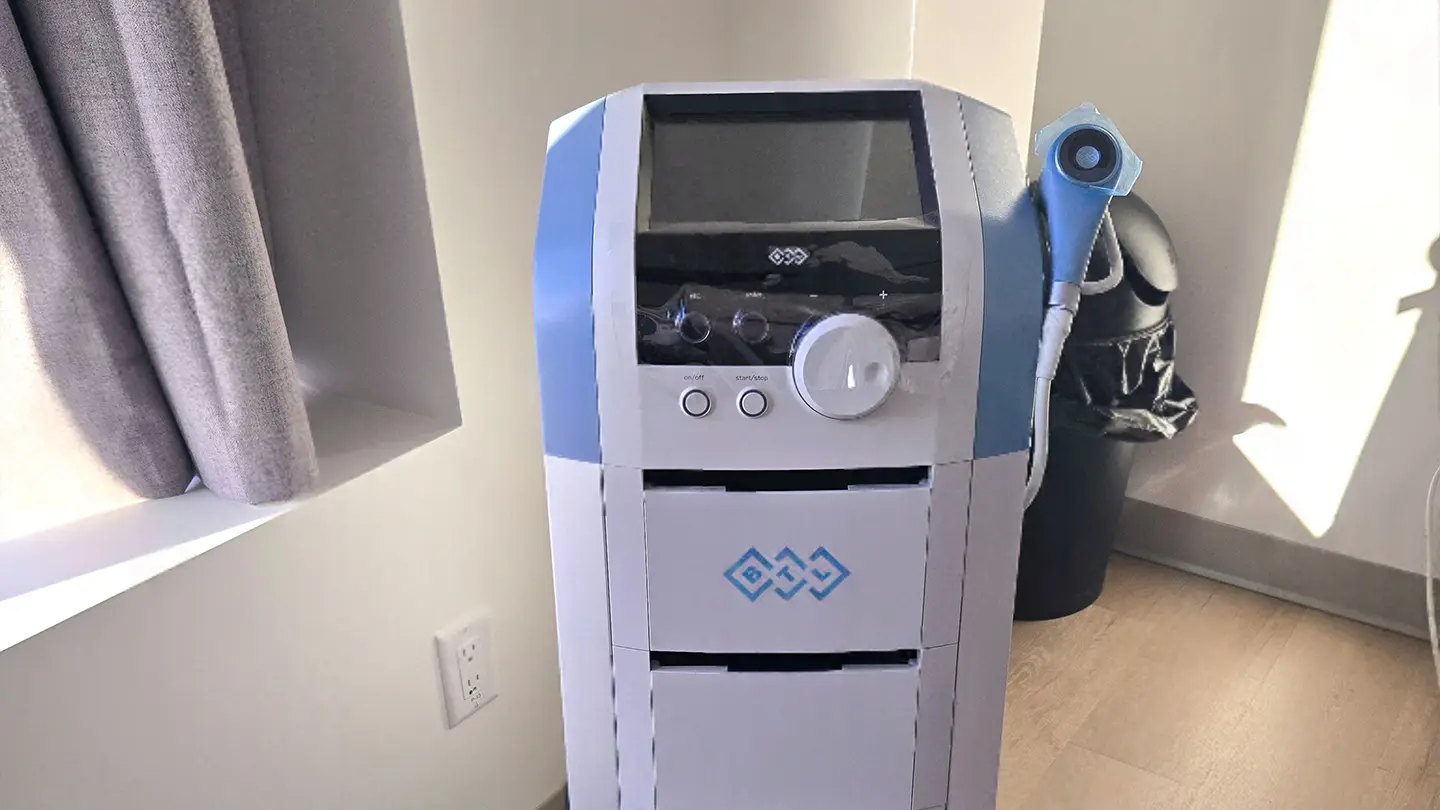
Your physiotherapist puts gel on the skin and presses the handpiece over the sore area. You’ll feel a fast, repeated tapping or pulsing, and you’ll hear the machine working.
It can be uncomfortable, especially over the most tender spot. The Royal National Orthopaedic Hospital describes it as sometimes a bit painful but tolerable for most people, and says the dose can be adjusted if it isn’t. The shockwave part itself is short. Kent Community Health NHS Foundation Trust says treatment usually lasts between two and five minutes.
At Refined, shockwave happens within your physiotherapy appointment, so it sits alongside the rest of your care, such as exercise and hands-on treatment, depending on your plan.
How many sessions research tends to use
There’s no single standard course. In the 2023 review, most of the trials used three sessions spread over about three weeks, and the range went from one to six. The Royal National Orthopaedic Hospital usually gives one session a week for three weeks, with more or fewer as needed, and keeps sessions no more than two weeks apart.
How many you’d need depends on your assessment and how you respond, and your physiotherapist will check your progress as you go.
Shockwave therapy side effects
Most people have some soreness after treatment. The Royal National Orthopaedic Hospital lists increased pain, bruising, redness, swelling, numbness, tingling and skin irritation as possible side effects. Most settle within a couple of days, and normally within a week. In rare cases they last longer.
There’s also a small risk of a tendon or the plantar fascia tearing, or of damage to the surrounding soft tissue. It’s uncommon, and it’s one reason your physiotherapist asks about past injuries and injections first.
Hospital leaflets usually ask you to avoid strenuous or high-impact activity on the treated area for 48 hours afterwards. Some also suggest skipping ice and anti-inflammatory medicines like ibuprofen for a short time after treatment. Check with your doctor or pharmacist before changing any medication.
Who should not have shockwave therapy
Shockwave isn’t for everyone. The Royal National Orthopaedic Hospital and Kent Community Health list reasons not to have it, including:
- Being pregnant or trying to conceive
- Being under 18
- A bleeding or clotting disorder, or taking blood thinners such as warfarin or rivaroxaban. Antiplatelet medicines such as aspirin or clopidogrel may also rule it out
- A pacemaker or other heart device, or an unstable heart condition
- Cancer, or a tumour where the treatment would go
- An infection or acute inflammation where the treatment would go
- A steroid (cortisone) injection into the area in recent weeks
- A current blood clot (thrombosis), or epilepsy
- Taking a type of antibiotic called a fluoroquinolone
- A recent fracture nearby, or reduced feeling in the area
The exact list varies a little from one hospital to the next. Your physiotherapist will go through your health history first, so mention your medications, any pregnancy, implants and past injections. If shockwave isn’t right for you, other physiotherapy options remain.
Shockwave therapy physiotherapy at Refined
Refined’s physiotherapists use shockwave therapy, along with ultrasound and laser therapy, for problems like plantar fasciitis and long-standing tendon pain. You can see the units on our equipment page.
Shockwave isn’t a separate appointment type. You book a physiotherapy visit, and your physiotherapist starts with an assessment of what’s driving your pain. If shockwave suits your situation, they’ll explain what it involves and why they’re suggesting it, so you can decide together. Read more about physiotherapy in South Surrey. If heel pain is your main concern, our post on plantar fasciitis and morning heel pain covers what you can try at home.
How massage therapy can help
Tight calves and a tense foot often come with heel and Achilles pain. A registered massage therapist can work on the calf, the Achilles area and the foot to ease that tension, alongside your exercise plan. Read more about registered massage therapy in South Surrey.
How kinesiology can help
A kinesiologist assesses how you move and builds an exercise program around what you want to get back to, such as running or long shifts on your feet. Our post on kinesiology vs physiotherapy explains how the two differ.
Common questions
Does shockwave therapy work for everyone?
No. The research is strongest for plantar fasciitis and for calcium deposits in the shoulder, and weaker for Achilles and patellar tendon pain. Some people don’t improve with it, which is why it’s used as part of a wider plan.
Does shockwave therapy hurt?
It can be uncomfortable while it’s happening, especially over the sorest spot. The intensity can be adjusted, so let your physiotherapist know how it feels. Some soreness for a day or two afterwards is common.
Can I have shockwave therapy while pregnant?
No. Pregnancy, and trying to conceive, are on the list of reasons not to have it. Other physiotherapy treatment can still help with aches and pains during pregnancy.
Can I book shockwave therapy on its own?
At Refined, shockwave is used during a physiotherapy appointment rather than booked separately, so you book physiotherapy. Coverage varies by plan, so check yours. Direct billing is available.
Do I need a referral?
No. Physiotherapy is direct access in BC, though some extended health plans require a doctor’s referral for reimbursement. We wrote more about referrals for physiotherapy in BC.
Book a visit at Refined
You can book physiotherapy at rih.janeapp.com. If you’re not sure where to start, call us at (604) 606-7519 and we’ll help you work it out.
This post is general information, not medical advice. Please speak to a doctor or physiotherapist about your own health, or call HealthLink BC at 8-1-1 for health advice. In an emergency, call 9-1-1. The research summarized here was checked in November 2026.
This entry is general information. For advice about your own situation, book an assessment with one of our practitioners.
Sources
- Systematic review and meta-analysis in Frontiers in Immunology pmc.ncbi.nlm.nih.gov
- HealthLink BC healthlinkbc.ca
- Systematic review in the Annals of Internal Medicine pubmed.ncbi.nlm.nih.gov