


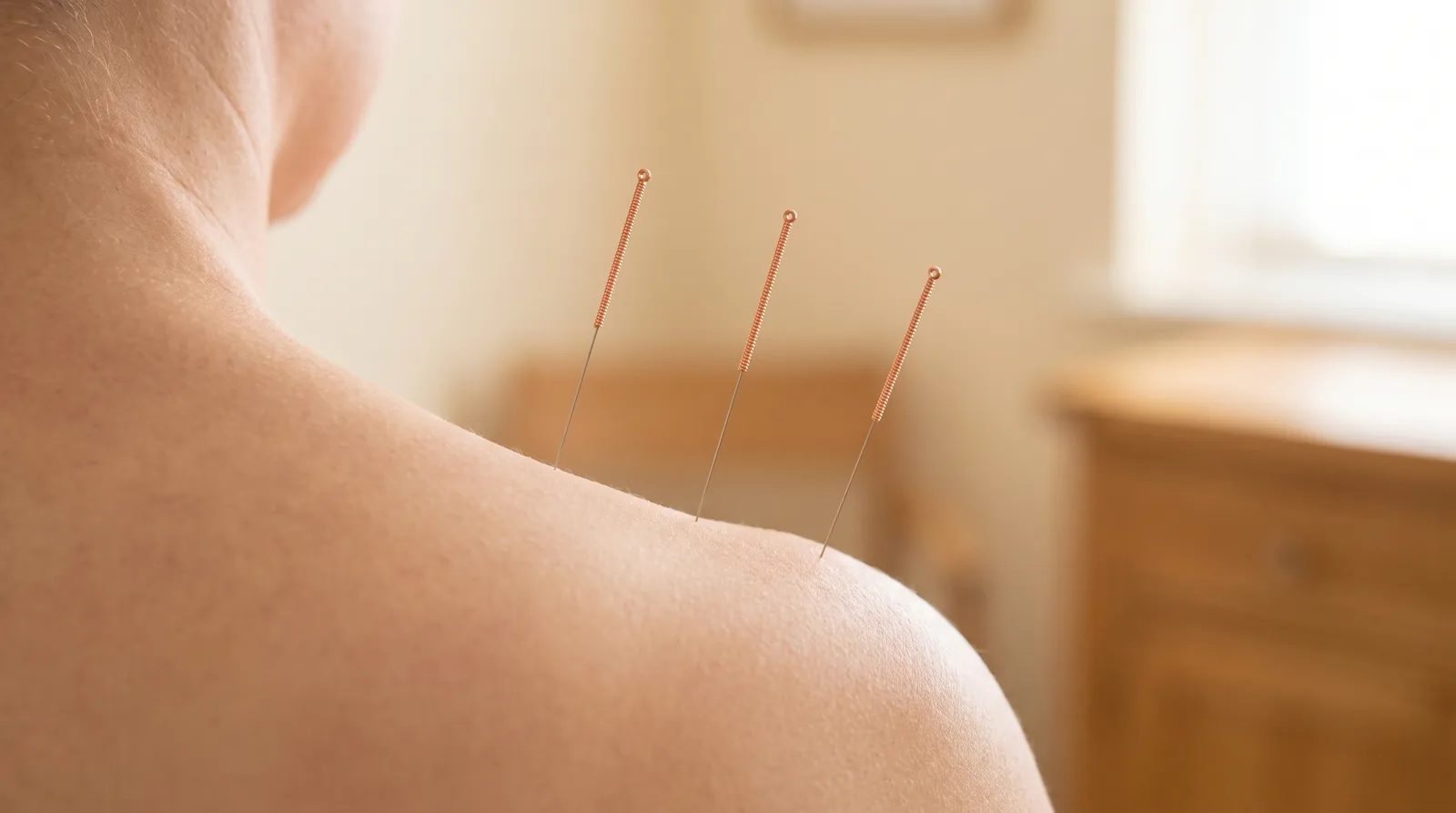
Mostly, no. You feel the needle go in about half the time, and when you do it is a brief prick that fades in a second or two. What comes after is a duller, heavier sensation that most people describe as strange rather than painful. It should not be sharp, and it should not keep hurting.
That is the honest version. Not “you won’t feel a thing”, because you will feel something, and being told otherwise is why people flinch and lose trust the first time a needle actually registers.
What the needles are actually like
The mental picture most people bring is the needle from a blood test, and that is the wrong picture entirely.
Acupuncture needles are solid and extremely fine. A needle used to draw blood is hollow, because it has to carry fluid, and that hollow tube is what gives it a wide bore and a cutting edge. An acupuncture needle carries nothing. It is closer to a strand of hair in thickness, flexible enough to bend, and it separates tissue rather than cutting through it. The US National Center for Complementary and Integrative Health describes the technique as inserting fine needles into the skin, and notes that acupuncture needles are regulated as medical devices and required to be sterile and single use.
Single use is worth saying plainly. The needle used on you comes out of a sealed package, goes in once, and goes straight into a sharps container afterwards. It is never reused on anyone, including you.
What you feel when a needle goes in
Insertion is quick. Some points you will not notice at all. Others give you a small sharp pinch, roughly on the order of a hair being plucked, and it is over more or less as soon as you register it.
Where the needle goes matters more than you might expect. Fleshy areas like the upper back, shoulders, and glutes tend to be the quietest. Hands, feet, ankles, and anywhere the skin sits directly over bone are more sensitive, and those points are the ones people remember. If a particular point is consistently unpleasant for you, say so, because there is almost always more than one way to treat the same thing.
The heavy, dull feeling nobody warns you about
Once the needle is in, you may notice a spreading, aching, heavy or slightly numb sensation around it. This has a name in traditional Chinese medicine, de qi, and it is the sensation practitioners are often working toward rather than trying to avoid.
In the research literature people describe it with words like dull, aching, heavy, spreading, and tingling, which is a very different vocabulary from sharp or burning. A review of de qi in clinical studies catalogues that range in detail.
It surprises people because it does not feel like anything else. It can also travel, so a needle in your forearm produces a feeling that moves toward your hand. That is normal. It is not a sign something has gone wrong.
What it should not feel like
This is the part worth memorising, because it is the difference between a normal session and one where you should speak up.
Tell your practitioner if you feel a sharp, electric, burning or radiating pain that does not settle within a few seconds. Tell them if a sensation gets more intense rather than less after the needle is placed. Tell them if you feel lightheaded, clammy, or unwell at any point.
None of those are things you should sit quietly through. A needle can be adjusted or removed in seconds, and there is nothing awkward about saying so. Practitioners would far rather adjust a needle than have you spend twenty minutes tense on the table.
How you might feel afterwards
Most people feel relaxed, and a fair few feel noticeably sleepy for the rest of the day. Some feel a bit spacey for an hour.
Mild soreness at the needle sites is common and usually fades within a day, similar to the dull feeling after a deep massage. Occasionally a point bruises slightly, most often on the hands, feet, or anywhere with vessels close to the surface. Serious complications from acupuncture are uncommon, though NCCIH notes that they have resulted from non-sterile needles and improperly delivered treatment, which is the argument for seeing a registered practitioner rather than the cheapest available option.
If you are genuinely afraid of needles
Say so when you book, and say it again when you arrive. It changes how the session runs.
A practitioner who knows can start with fewer needles, use shallower insertion, work on the points you are least worried about first, and keep you lying down and talking rather than left alone in silence. You can also keep your eyes closed or turned away, which helps more people than they expect.
Needle anxiety is common enough that it is a routine conversation, not an admission. Nobody is going to talk you out of it or push you further than you agreed to.
Does it depend on which treatment you book?
Somewhat, yes.
Standard acupuncture is what everything above describes. Some sessions may include cupping, which is not needling at all and feels like strong suction, and may leave circular marks that fade over several days.
Depending on your practitioner, a session might also involve gentle electrical stimulation attached to the needles, which feels like a light tapping or buzzing, or acupressure, which uses firm finger pressure instead of needles. Not everyone on our team offers every technique, so if there is something you specifically want or specifically want to avoid, mention it when you book.
Common questions
How many needles will be used?
It varies with what is being treated, and your practitioner will tell you what they are planning before they start. You can always ask for fewer.
How long do the needles stay in?
Usually somewhere in the range of fifteen to thirty minutes, with you resting on the table. Most people find this part relaxing, and plenty fall asleep.
Does it bleed?
Rarely, and when it does it is a single small bead at one point, dabbed away immediately. Bruising is more common than bleeding and is still not common.
Can I go back to work afterwards?
Most people do. If it is your first session, it is worth not scheduling anything demanding straight after, purely because feeling drowsy afterwards is common and easier to enjoy than to fight.
Is it safe if I am pregnant or on blood thinners?
Both are things to raise before your appointment rather than assume either way. Tell your practitioner about any medication you take and any medical conditions you have, and they will adjust the treatment or tell you if something is not appropriate.
Ready to try it?
If needles were the only thing holding you back, now you know roughly what to expect, including the parts nobody mentions. You can book acupuncture in South Surrey at rih.janeapp.com, or call (604) 606-7519 if you would rather ask a few questions first.
Not sure acupuncture is the right starting point at all? Our guide to whether to book RMT, physio, or acupuncture walks through what each one is good at.