


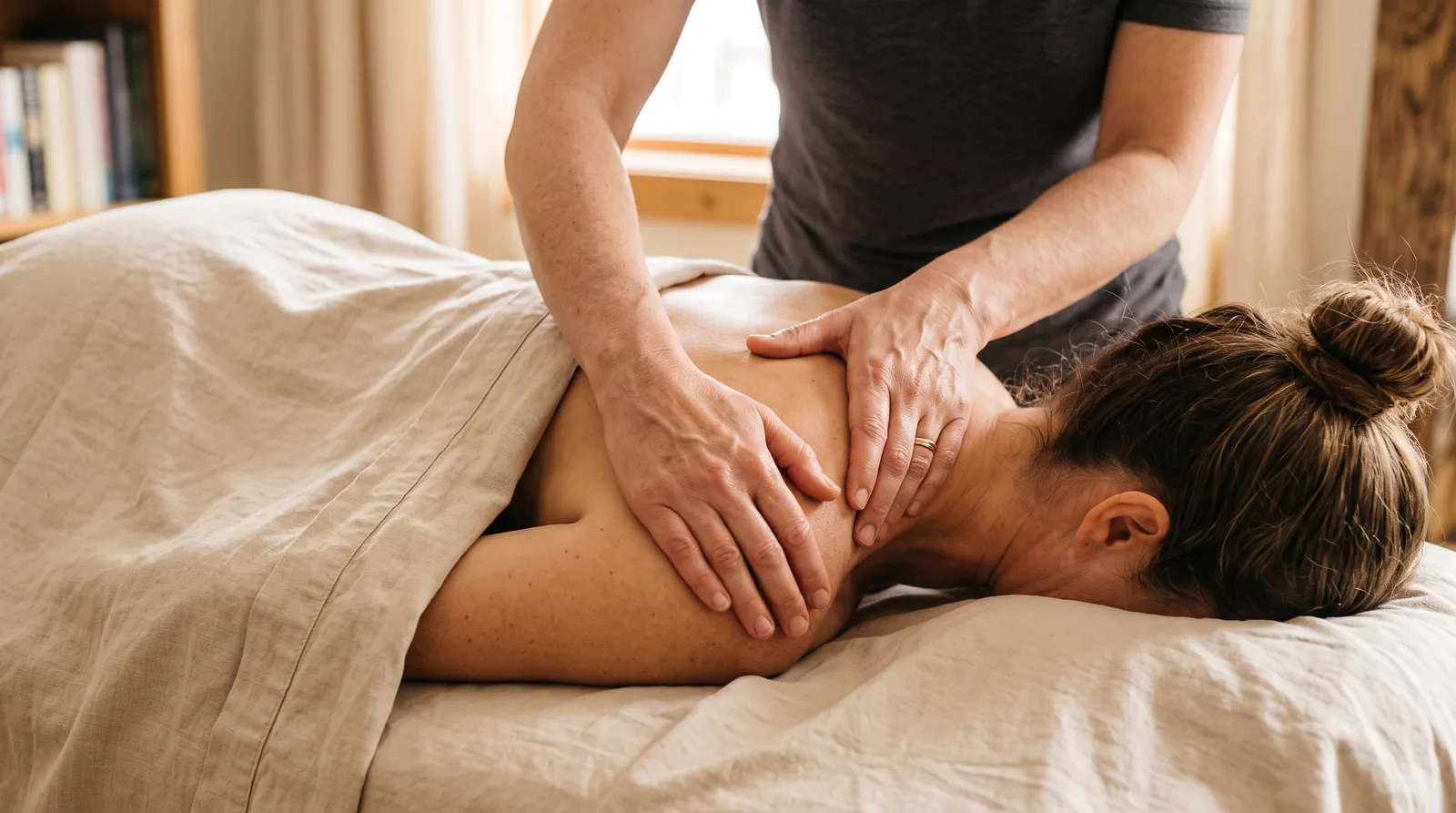
It depends entirely on what you are trying to do. If you are working on a specific problem, a short run of weekly sessions usually beats the same number of appointments spread across six months. If you are managing stress or a long-standing condition, every two to four weeks is where most people land. There is no single correct number.
That is a less satisfying answer than a rule, so here is how to work out yours.
If you are treating a specific problem
This is the situation where frequency matters most, and where spacing sessions too far apart genuinely wastes them.
If you have come in with a stiff neck, a sore shoulder, or tension headaches that have been building for months, the tissue and the habits behind it took a while to get that way. One session can absolutely take the edge off, but the change often fades before the next appointment if that appointment is five weeks out.
A more useful shape is a short concentrated run. Weekly for three or four weeks, then reassess honestly. Is it better, is it the same, is it better for two days and then back. That answer tells you more than any general recommendation could.
This is also roughly what the research points at. A summary of massage therapy research from the US National Center for Complementary and Integrative Health describes a trial in people with chronic neck pain where multiple 60 minute sessions per week over four weeks did better than shorter or less frequent ones. The evidence in this area is not enormous and the effects tend to be short term, which is worth knowing rather than glossing over.
If you are managing something ongoing
Long-standing back pain, a physically demanding job, a condition that flares up predictably. Here the goal is not to fix something and stop, it is to keep it manageable.
Most people in this position settle somewhere between every two weeks and every four weeks. The way to find your number is to notice when the benefit wears off. If you feel good for three weeks and then the last week before your next appointment is rough, you have found your interval, and it is three weeks.
Paying attention to that gap is more useful than picking a frequency in advance and sticking to it out of habit.
If it is mostly for stress and general wellbeing
Monthly works well for a lot of people, and there is no clinical reason to go more often if you feel good.
The honest note here is that monthly massage is not going to undo a schedule that is genuinely too much, and it is not meant to. It is one useful thing among several, and it is fine to book it simply because it helps you feel better.
If you are recovering from an injury or a crash
Frequency here is usually set by your treatment plan rather than by preference, and it often starts higher and tapers as you improve.
If your massage therapy is part of an ICBC claim, the number of pre-approved treatments and the window they fall in shape the schedule too. Those are worth understanding early rather than discovering halfway through.
What the research actually supports, and what it does not
Worth being straight about this, because the wellness industry is not.
There is reasonable evidence that massage helps in the short term with things like chronic low back pain and neck pain, and that longer, more frequent sessions tend to outperform shorter, sparser ones during a treatment course. The strength of that evidence is generally rated as low to moderate, and the benefits are usually measured over weeks rather than years.
What that means practically is that massage is a good tool for symptom management and a poor substitute for the other things that address the cause, whether that is loading the tissue properly, changing how you work, or getting an actual diagnosis for a problem nobody has assessed yet. A massage therapist worth seeing will tell you that rather than booking you in indefinitely.
Signs your interval is wrong
A few practical tells.
You are probably going too infrequently if you arrive every time in the same state you were in before your first appointment, if the benefit lasts less than a few days, or if you find yourself describing the same problem in the same words every visit.
You may be going more often than you need if you feel good throughout the gap and cannot really tell the difference afterwards, or if you are booking out of routine rather than because anything is bothering you. That is not a problem if you enjoy it and can afford it. It is worth noticing, though, because that budget might do more somewhere else.
What your budget and benefits will actually allow
Frequency is a clinical question and a financial one, and pretending otherwise helps nobody.
Most extended health plans set an annual maximum for massage therapy, often a dollar amount rather than a number of visits, and sometimes a per-visit cap as well. Divide your annual maximum by the cost per session and you have the real number of covered visits in a year. Working out that number before you plan a schedule saves an unpleasant surprise in October.
If you receive MSP supplementary benefits, the province contributes $23 per visit toward a combined annual limit of 10 visits, shared across massage therapy, physical therapy, acupuncture and several other therapies together. The current details are on the province’s supplementary benefits page.
If your budget only stretches to six sessions a year, six well-timed sessions during a flare-up will do more for you than six scattered evenly across twelve months.
Common questions
Is it possible to get massage too often?
For most healthy adults, frequent massage is not harmful, though going very often can leave you feeling sore rather than better. If you are consistently tender for days afterwards, that is a conversation about pressure and frequency with your therapist.
Should I book weekly forever?
Generally no. Weekly makes sense as a short course while you are working on something specific. Once it settles, most people step down to a longer interval rather than continuing indefinitely.
Does a longer appointment work better than a more frequent short one?
For a specific problem, session length does appear to matter, and the research favours 60 minute sessions over 30 minute ones. If you have to choose between a shorter massage more often and a longer one less often, a longer one is usually the better buy.
Can I combine massage with physiotherapy?
Yes, and lots of people do. They do different jobs, and they are often scheduled to complement each other rather than to overlap.
Does it need to be deep to be doing anything?
No. Pressure should be firm enough to be effective and never so much that you are bracing against it. Tensing up through a massage works against the point of it, and more pressure is not automatically more benefit.
Working out your number
If you are not sure where to start, start with a conversation rather than a package. Book a single appointment for registered massage therapy in South Surrey at rih.janeapp.com, describe what you are dealing with, and ask your therapist what they would suggest for the next month.
If part of the question is whether massage is even the right service for what you are dealing with, our guide to whether to book RMT, physio, or acupuncture is a good place to start.