



You stretch. You rest. You feel better for a few days. Then you bend down to pick something up and there it is again, that same tightness in your lower back, like it never really left.
If that sounds familiar, you’re not imagining it and you’re not doing anything wrong. Back pain that keeps returning is one of the most common things we see at Refined Integrated Health, and it usually has less to do with one single injury and more to do with patterns that build up over time.
It’s also one of the most frustrating things to deal with, because it rarely announces itself with a clear cause. Sometimes it’s a single awkward lift. More often, it’s a slow buildup from sitting at a desk all day, a long stretch without much movement, or an old strain that never got the chance to fully settle before life demanded you keep going. By the time the pain shows up, it can feel disconnected from whatever actually caused it, which makes it hard to know what to do differently, or even who to see about it.
That last part trips a lot of people up. Physio, massage, acupuncture, they can all play a role, and the right mix often depends on what’s actually going on. Here’s how our team at Refined thinks about it.
Why the same back pain keeps showing up
Most recurring back pain isn’t really about the back at all. It’s about everything around it.
Here’s what tends to happen. An area gets irritated, maybe from sitting too long, lifting awkwardly, or an old injury that never fully settled. The body responds by tightening up nearby muscles to protect the area. That protection is useful at first. It’s your body doing exactly what it’s supposed to do when something feels vulnerable. The problem is when those muscles stay tense long after the original irritation has calmed down, and the rest of your body starts compensating around the tension.
Researchers actually have a name for this: muscle guarding, where the lower back muscles stay switched on far more than they need to, even during simple movement like walking. Studies looking at people with ongoing low back pain have found their back muscles working overtime during activities that shouldn’t require much effort at all, staying braced through movements where a pain-free back would relax.
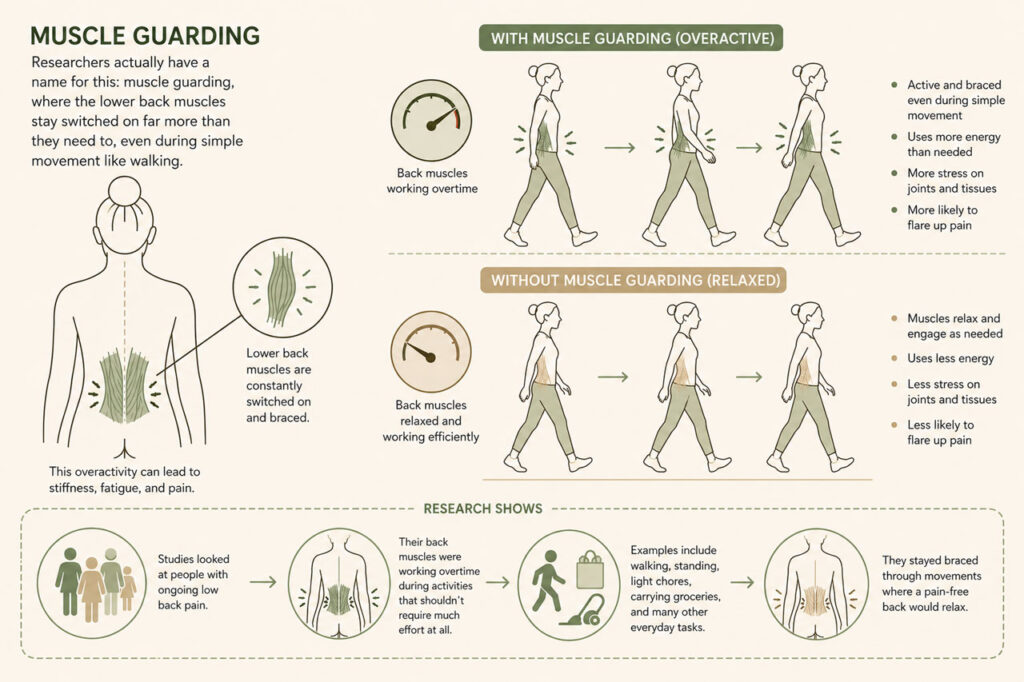
Over time, you end up with a cycle. The tight muscles limit how you move. The limited movement puts more strain on the joints and muscles nearby. That strain flares up, and the tightness comes right back to protect it again. You feel like you keep re-injuring the same spot, when really the spot never got the chance to fully recover in the first place, because the muscles around it never stopped bracing long enough to let it.
This is also why rest alone often doesn’t fix it. Rest can calm things down temporarily, but if the underlying movement pattern that caused the strain hasn’t changed, the pain has every reason to come back once you’re active again. You go back to the same desk chair, the same way of bending to load the dishwasher, the same way of standing with your weight shifted onto one hip, and the same strain builds right back up.
This is also part of why back pain can feel so unpredictable. One week you can lift boxes all afternoon with no issue. The next, you tweak something reaching for a coffee mug. That’s not randomness. It’s usually a sign that the underlying tension and compensation pattern has been building quietly in the background, and the coffee mug just happened to be the moment it tipped over.
Physiotherapy: getting to the root of the pattern
When back pain keeps returning, physiotherapy is usually the place to start, because it looks at how you move as a whole system rather than just the sore spot.
A proper assessment includes watching how you walk, how you bend, how your hips and core work together, and where you might be compensating without even noticing. Someone with tight hips might be putting extra strain on their lower back with every step. Someone with a weak core might be relying on their back muscles to do a job they were never meant to do alone. Someone who spends most of the day sitting might have glutes that have essentially forgotten how to fire properly, which quietly shifts the workload onto the lower back with every stand up, every stair, every walk to the car.
It’s also worth saying plainly that back pain rarely means something is broken or damaged. For most people with recurring back pain, imaging like an X-ray or MRI doesn’t reveal anything alarming, because the issue isn’t structural, it’s functional. The tissue is fine. The pattern around it isn’t.
Treatment usually combines hands-on work to calm down the immediate tension with targeted exercises that retrain the muscles that aren’t pulling their weight, so your back stops overworking to make up for it. For back pain that’s been sticking around for a while and hasn’t responded to typical treatment, IMS (intramuscular stimulation) is sometimes brought in as an additional tool, using a fine needle to release the muscle at the specific point of tension. Learn more about physiotherapy at Refined.
Massage therapy: releasing the tension that’s built up
While physio works on retraining the pattern, registered massage therapy works directly on the tension that pattern has created in your muscles, and the two often support each other well.
Deep tissue work and myofascial release can ease the chronically tight muscles around the lower back and hips that have been guarding for weeks or months, giving your body a chance to move more freely between physio sessions. Trigger point therapy targets specific knots that tend to form in overworked muscles, often in the same spots that keep flaring up. For a lot of people, this combination of loosening the tension through massage and retraining the pattern through physio moves things along faster than either approach alone.
Massage can also simply help you feel human again while the rest of the plan does its work. Chronic tension is exhausting, and a treatment focused on calming your nervous system alongside your muscles is valuable in its own right, not just as a supporting act. Learn more about registered massage therapy at Refined.
Acupuncture: a different way of addressing the tension
Acupuncture takes a different approach to the same underlying problem, and for some people it’s a helpful addition alongside physio or massage, or a starting point in its own right.
Fine needles placed at specific points can help ease muscle tension, encourage circulation, and support the body’s own pain response, particularly for the kind of chronic, low-grade tightness that comes with long-standing back pain. Cupping is commonly used alongside traditional needling, and depending on your practitioner and what your body responds well to, electro-acupuncture may also be part of the plan.
Acupuncture tends to appeal to people who’ve tried more conventional approaches without lasting relief, or who simply prefer a treatment style that works with the body’s regulation systems rather than through exercise or manual pressure. It’s not a replacement for addressing the movement pattern behind the pain, but as part of a broader plan, it can genuinely help. Learn more about acupuncture and TCM at Refined.
So which one should you actually book
Honestly, there’s no single right answer, and that’s the point of having all three under one roof. If your pain is closely tied to a movement pattern (weak core, tight hips, poor posture from your job) physiotherapy is usually the right place to start. If the tension itself feels like the main issue and you’re looking for relief while a longer-term plan comes together, massage therapy can help right away. If you’ve tried the more conventional routes without lasting change, acupuncture is worth exploring.
Because our practitioners work together under one roof, you’re never locked into guessing. Our front desk team can help point you toward the right starting place based on what you describe, and it’s common for patients to use more than one of these services as part of the same recovery plan.
Common questions about back pain treatment
How long does it usually take before I notice a difference?
It varies depending on how long the pattern has been building and which treatment approach you start with, but most people start noticing changes within the first few sessions.
Do I need a referral to book any of these services?
No referral is needed to book physiotherapy, massage therapy, or acupuncture at Refined.
Is it normal for my hip or leg to feel involved too?
Yes. Since back pain is often connected to how the whole body moves, it’s common for tightness or discomfort to show up in the hips, glutes, or legs as well.
What if my back pain is from a car accident?
If your back pain is related to a motor vehicle accident, physiotherapy and massage therapy at Refined are both covered through ICBC. You can read more on our ICBC claims page. ICBC appointments are booked by email at [email protected] so our team can confirm your claim details ahead of your first visit.
Can I combine physio, massage, and acupuncture at the same time?
Yes, and many patients do. Since all three are offered at Refined, your practitioners can coordinate so the treatments support each other rather than working at cross purposes.
Will I need X-rays or imaging before starting treatment?
Not usually. Most recurring back pain is a functional issue rather than a structural one, so a thorough assessment is typically enough to guide treatment. If something in your history suggests imaging would be useful, your practitioner will discuss that with you directly.
Ready to stop starting over
If your back pain keeps circling back no matter what you try, the goal isn’t another round of temporary relief. It’s understanding what’s actually driving it, and choosing the right combination of care to address it.
Book physiotherapy, massage therapy, or acupuncture at rih.janeapp.com, or call us at (604) 606-7519 if you’d like help figuring out where to start.